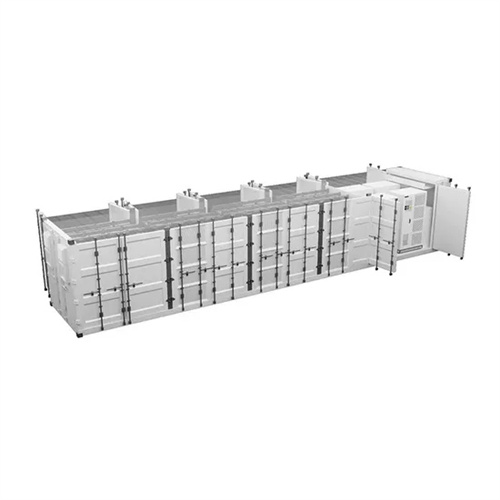
Government of St. Kitts and Nevis, SKELEC and Leclanché Commence Construction of Caribbean’s Largest Solar Generation and Storage SystemInnovative, fully integrated solar photovoltaic generation and lithium-ion battery energy storage system, will displace 30-35% of the islands’ diesel-generated baseload powerSustainable microgrid system to reduce CO2 emissions by more than 740,000 metric tons over 20 years.
Government of St. Kitts and Nevis, SKELEC and Leclanché Commence Construction of Caribbean’s Largest Solar Generation and Storage SystemInnovative, fully integrated solar photovoltaic generation and lithium-ion battery energy storage system, will displace 30-35% of the islands’ diesel-generated baseload powerSustainable microgrid system to reduce CO2 emissions by more than 740,000 metric tons over 20 years.
Upon completion, the St. Kitts project will be the largest solar generation and energy storage system in the Caribbean and a model for other island nations worldwide.
[pdf] What sources make up our electricity mix? How much comes from coal, oil, and gas, and how much from nuclear, hydropower, solar, or wind? In the interactive charts shown here, we see the breakdown of the electricity mix by source. The stacked area chart shows electricity production in absolute terms, allowing you to. .
The chart below shows the percentage of global electricity production that comes from nuclear or renewable energy, such as solar, wind, hydropower, wind and tidal, and some biomass. Globally, more than a third of our electricity. .
Carbon intensity of electricity measures the amount of CO2 produced per unit of electricity. It is measured as the grams of CO2 produced per kilowatt.
[pdf] 
Global demand for Li-ion batteries is expected to soar over the next decade, with the number of GWh required increasing from about 700 GWh in 2022 to around 4.7 TWh by 2030 (Exhibit 1). Batteries for mobility applications, such as electric vehicles (EVs), will account for the vast bulk of demand in 2030—about 4,300 GWh; an. .
The global battery value chain, like others within industrial manufacturing, faces significant environmental, social, and governance (ESG) challenges (Exhibit 3). Together with Gba members representing the entire battery value. .
Some recent advances in battery technologies include increased cell energy density, new active material chemistries such as solid-state batteries, and cell and packaging production technologies, including electrode dry. .
The 2030 Outlook for the battery value chain depends on three interdependent elements (Exhibit 12): 1. Supply-chain resilience. A resilient. .
Battery manufacturers may find new opportunities in recycling as the market matures. Companies could create a closed-loop, domestic supply chain that involves the collection, recycling, reuse, or repair of used Li-ion.
[pdf]